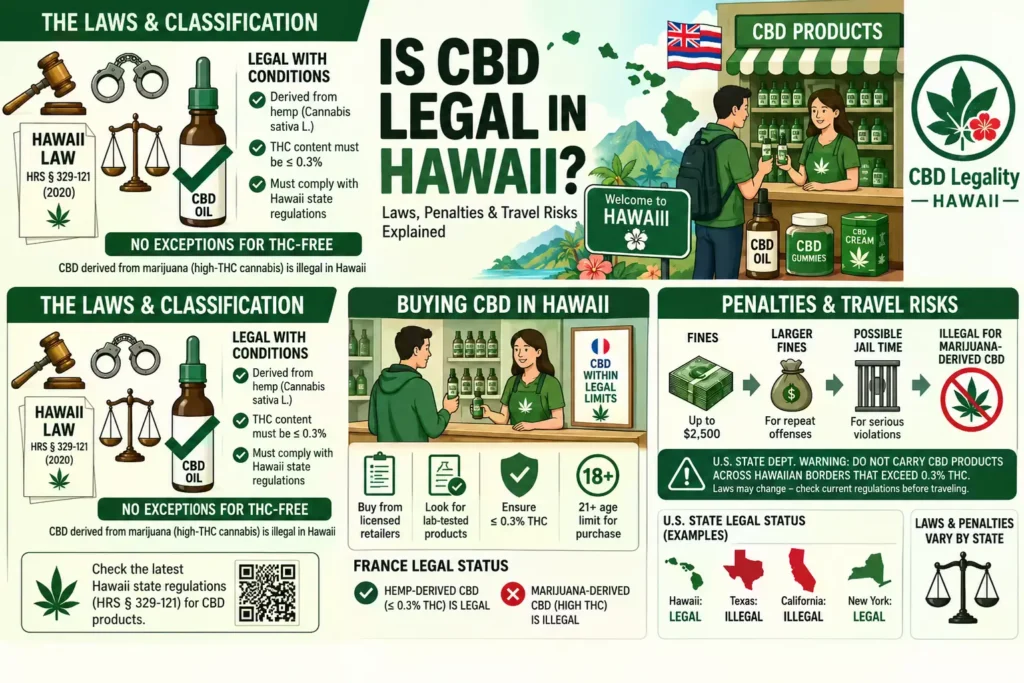

CBD is legal in Hawaii, but in limited forms. CBD derived from hemp can be sold in tinctures, beverages, softgels, capsules, powders, topicals, tablets, and gummies, as well as oil-based products, with strict state limits. The total amount of THC in an edible unit shall not exceed 1 milligram and the total amount of THC in a package shall not exceed 5 milligrams. The use of smokable hemp, vapes and foods containing CBD like chocolate are not allowed. Tinctures are only available for purchase to adults 21 years of age and older. The majority of edible products must be purchased from a retailer who is registered with the Department of Health and the regulation was implemented on July 1, 2026.
Key Takeaways
- CBD derived from hemp is legal in Hawaii in a limited number of forms. There is no limit to the amount of CBD in a product in Hawaii.
- Total THC is limited to 0.3 percent by weight, and there are milligram limits per unit and per package.
- Hemp flower, pre-rolls, vape cartridges, concentrates, CBD foods and synthetic cannabinoids like delta-8 THC are prohibited.
- Tinctures are only available to 21+ customers who will be checked for identification.
- There is no requirement that you need to have a medical card to purchase hemp products.
- The federal hemp definition update will go into effect Dec. 11, 2026, for most products.
Will CBD be legal in Hawaii in 2026?
Hemp-derived CBD can be sold in Hawaii in an approved form and in compliance with Hawaii’s rules regarding THC, lab testing, labeling, and packaging.
In the 2018 Farm Bill, hemp, or cannabis with less than 0.3 percent delta-9 THC by dry weight, was removed from the federal Controlled Substances Act, but states were allowed to have stricter regulations. The Hawaii Department of Health consumer FAQ states that the State determines which hemp products can be sold, and a 2020 law set this up. Hawaii now has two separate cannabinoid systems: medical cannabis and hemp, said the state’s cannabis control chief to legislators.
The Rules that govern Hemp CBD
Hemp processors are regulated under Hawaii Revised Statutes (HRS) Chapter 328G. Product standards are established in Chapter 11-37 of the Hawaii Administrative Rules, and the registration of retailers was added to the act by Act 269 of 2025. Governor Josh Green, a doctor, said the regulations institute “robust safety measures to protect public health”.
What are the allowed CBD products in Hawaii?
Only manufactured hemp products (as defined by the State) can be sold. Each product allowed must also meet a total THC (tetrahydrocannabinol) limit of 0.3 percent by weight, pass batch testing, and be properly labeled.
| Product form | THC limits | Buyer and retailer rules |
| Gummies, tablets, capsules, powders, softgels, gelcaps | 1 mg total THC per unit, 5 mg per container | Sold by a registered retailer, in child-resistant packaging |
| Oil-based tinctures | 3 mg per serving, 85 mg per bottle, one ounce maximum | Buyer must be 21 or older with ID checked |
| Beverages | 0.5 mg per container, 6 to 12 fluid ounces | Sold by a registered retailer |
| Topicals | 0.3 percent total THC by weight | No retailer certificate required |
The container limit is an effective limit. The total amount of THC in a 30-gummy jar can be a maximum of 5 milligrams. Gummies also may not look like candy or be shaped like a person, animal, fruit or cartoon character.
What CBD Products are Illegal in Hawaii?
The following is banned by the Department of Health regardless of what the label states about the amount of THC in the product:
- Hemp flower, leaf material, viable seeds and pre-rolls
- Any vape cartridge or concentrate which states it contains a certain cannabinoid such as CBD.
- Items like chocolate, honey, baked goods, and candies that contain cannabinoids.
- Artificially produced cannabis compounds such as delta-8 THC, delta-10 THC, THCO, THC-P, HHC and CBN derived from CBD.
- Alcohol, kava, caffeine or nicotine in edibles or topicals
Smokables and vapes have “never been legal under Hawaii law,” said Andrew Goff, director of the state’s Office of Medical Cannabis Control and Regulation, to Hawaii News Now.
Where and who can purchase CBD in Hawaii?
All packages must include the disclaimer: Not for sale to minors. The age restriction is a legal sales restriction for tinctures and retailers are required to check identification.
Retailers, distributors, and online sellers of most edible hemp products have been required to have a Certificate of Registration from the Department of Health since January 2026. The cost for 5 years is $50. Tinctures, topicals and hemp seed foods are exempt. The requirement extends to out-of-state sellers who ship to Hawaii, per Maui News. Consumers can view the Department’s list of registered hemp retailers. If you are ordering from outside of the country, you should also read our article on CBD import laws.
Need a Medical Card?
No. The Department has not established a medical card requirement for hemp products. The medical cannabis program is a distinct system for marijuana-derived products sold via licensed dispensaries.
When did enforcement begin?
The grace period is over as of June 30, 2026. Hawaii News Now reported that less than 50 shops have registered for enforcement, which began on July 1st. Cease and desist orders, product seizure, and fines up to $10,000 per violation are possible penalties. A previous challenge by a retailer against the hemp rules by the state was unsuccessful as a federal judge ruled against granting a preliminary injunction.
The impact of Federal law on CBD in Hawaii
Hawaii’s rules are in addition to federal rules and sometimes conflict with them. The Food and Drug Administration has said that there is no approval for CBD to be added to foods or sold as a dietary supplement, and that only one CBD drug, Epidiolex, is approved. Unapproved products with medical claims, the agency warns, can “put patients at risk”. The Department of Health recognizes that products that are permitted in Hawaii are not permitted in accordance to FDA regulations.
A bigger change is on the horizon. The definition of hemp in Public Law 119-37 is based on total THC: no more than 0.4 milligrams of total THC per finished container. The change, which was originally scheduled to take effect Nov. 12, 2026, is described by the Congressional Research Service. Foley Hoag says it was put off to December 11, 2026 by a stopgap funding bill that was signed on September 2, 2026. The plant’s inability to naturally produce cannabinoids will mean that hemp will lose its status on November 12. The U.S. Hemp Roundtable believes that roughly 95 percent of hemp-based cannabinoid products would be federally illegal if the new standard were to be applied.
While the new federal rule is 10 milligrams of THC per container, Hawaii allows 5 milligrams per edible container. Therefore, hemp-derived CBD products that contain trace amounts of THC could potentially be subject to federal action even if state law permits them, while CBD isolate is the least likely to be subject to federal action. To get the big picture, check out Is CBD Legal in the US? Why is it that Federal law says yes, but State law says no?
How to Check a CBD Product Before Buying in Hawaii
A compliant package must show:
- The amount of THC in milligrams per serving, and the net weight
- The part of the plant that is used plus the hemp ingredient that is listed as “Hemp”
- A batch number and a QR code or web address that provides access to lab results.
- Not for sale to persons under 21 years of age” and “Keep out of reach of children”
- The information provided here is not intended to diagnose, treat, cure or prevent any disease.
All edibles and topicals are also required to be packaged in child-resistant packaging, and stores are not allowed to sell samples from open containers.
Conclusion
While hemp-derived CBD is legal in Hawaii, the state permits much less than most of the rest of the country. Select an approved form, check that the retailer is registered, compare the THC numbers with the limits above, and open the lab results. The federal definition of hemp will be changing on December 11, 2026 for most products, meaning rules could change again in the coming weeks.
For other jurisdictions, visit our Legal guides or US section. The state rules are interim – please review the Department of Health’s hemp program page prior to any purchase.
Frequently Asked Questions
Is CBD oil legal in Hawaii?
Yes. For adults 21 or older, hemp tinctures with oil can be sold legally, and up to 3 milligrams of total THC per serving and 85 milligrams per one-ounce bottle. Retailers will have to verify identification.
Is it legal to purchase CBD online and get it delivered to Hawaii?
Yes, if the product is within Hawaii limits. All out-of-state and sellers of edibles (except tinctures) must register with the Department of Health.
Is Delta 8 THC Legal in Hawaii?
Hawaii prohibits the sale of CBD or other cannabinoid-derived delta-8, delta-10, THCO, THC-P, HHC and CBN.
Can I smoke or vape CBD in Hawaii?
Not from a legal hemp retailer. Hemp flower, pre-rolls, vape cartridges and concentrates are not allowed for sale in Hawaii.
Are there any maximum amounts of CBD allowed in a product in Hawaii?
No. According to the Department of Health, Hawaii does not have a limit on the amount of CBD. The limits are for THC.
Could the federal hemp change the sale of CBD in Hawaii?
Not automatically. While state law still applies in Hawaii, most hemp products will be subject to a new definition by federal law on December 11, 2026. Please refer to the latest guidance before purchasing.