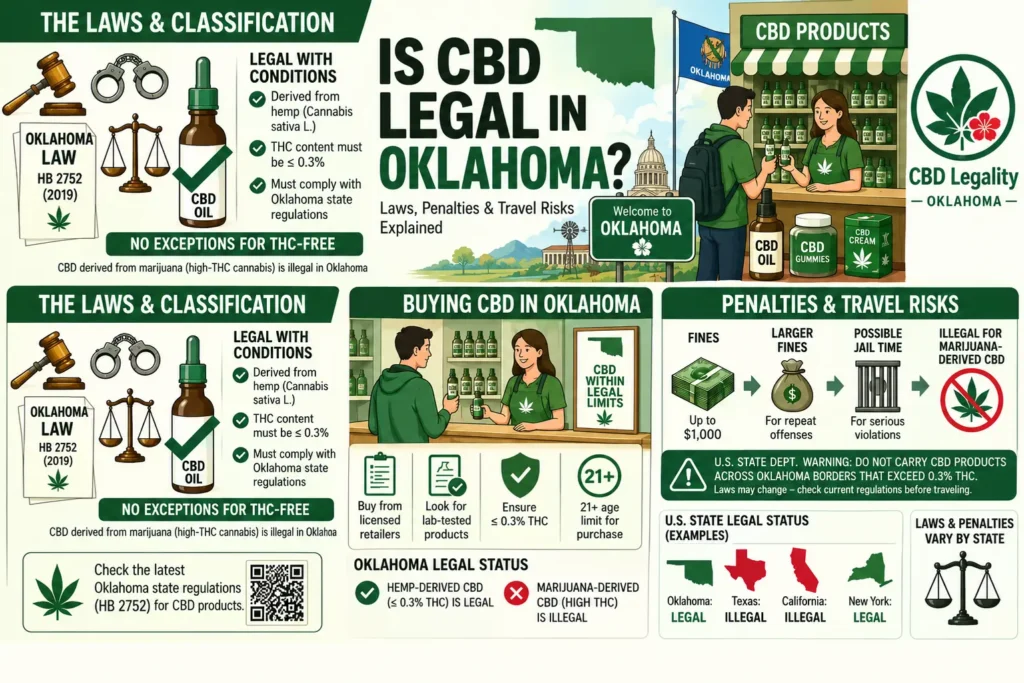

Yes, CBD is legal in Oklahoma. Hemp-derived CBD with no more than 0.3 percent total THC can be bought without a prescription or medical card, and Oklahoma law sets no separate statewide purchase age. A federal change will tighten the rules soon. Oklahoma’s Department of Agriculture applies it to hemp, and it caps a finished product at 0.4 milligrams of total THC per container, starting December 11, 2026 for most products. CBD isolate should pass that test, while many full-spectrum oils may not.
Key Takeaways
- Hemp-derived CBD is legal in Oklahoma when it tests at or below 0.3 percent total THC.
- No medical card or prescription is needed for hemp CBD. Marijuana-derived CBD is a separate matter.
- A federal cap of 0.4 mg of total THC per container applies to finished hemp products, mostly from December 11, 2026.
- Delta-8 and other synthesized cannabinoids lose hemp status.
- Isolate and lab-verified THC-free products are the safest choice.
Is CBD Legal in Oklahoma in 2026?
Hemp-derived CBD is legal in Oklahoma today if the product tests no higher than 0.3 percent total THC, and it must meet a stricter per-container limit once federal changes take effect.
Oklahoma regulates hemp through the Department of Agriculture, Food, and Forestry, known as ODAFF. The state’s Hemp Program grew from Senate Bill 868 in 2019, which defined industrial hemp, including its cannabinoids, at no more than 0.3 percent delta-9 THC on a dry-weight basis and excluded it from the definition of marijuana. ODAFF licenses growers, handlers, and processors. Legal summaries find no state license for hemp retailers. The Oklahoma Medical Marijuana Authority, or OMMA, oversees only the medical marijuana program.
What Did ODAFF’s 2026 Letter Say?
On January 16, 2026, Hemp Program Administrator Joshua Rigdon issued a clarification letter. It states that hemp products must test no more than 0.3 percent Total THC, which is THC plus 87.7 percent of THCA. It then describes the federal change in Public Law 119-37. Final hemp-derived cannabinoid products may contain no more than 0.4 milligrams of Total THC per container. The letter adds: “Containers are defined as the retail packaging (e.g., jars, bottles, cartridges).” Products over that limit “are not considered hemp and cannot be marketed as such.”
When Do the New Limits Take Effect?
ODAFF’s letter named November 12, 2026. Congress has since moved most of the change. A stopgap law, H.R. 6500, signed on September 2, 2026, delays most restrictions to December 11, 2026, while cannabinoids the plant cannot make naturally still lose hemp status on November 12. The letter predates the delay, so check ODAFF for updated guidance.
| Date | What changes |
|---|---|
| Now | 0.3 percent total THC standard applies |
| November 12, 2026 | Synthesized cannabinoids such as delta-8 lose hemp status |
| December 11, 2026 | 0.4 mg per container cap applies to most finished products |
How the 0.4 mg Cap Affects CBD Products
The cap is measured per retail container, so a larger bottle holds more oil and more trace THC. A label reading “less than 0.3 percent THC” no longer proves a product will qualify.
| Product type | Likely status | Reason |
|---|---|---|
| CBD isolate | Usually legal | Little or no THC if the lab report confirms 0.4 mg or less |
| THC-free broad-spectrum CBD | Legal if tested | Total THC must stay at or below 0.4 mg per container |
| Full-spectrum CBD oil | Often over the cap | Trace THC adds up across a full bottle |
| Delta-8 and similar isomers | Excluded from hemp | Synthesized outside the plant |
| THCA flower, high-THC edibles | Not hemp | Above the container cap |
Rachel Klubeck, an attorney at Gies Law Firm in Oklahoma City, wrote in June 2026 that pure CBD is not prohibited and that isolate with no more than trace THC may still qualify, while full-spectrum and some broad-spectrum products may not.
Where Can You Buy CBD in Oklahoma?
Hemp CBD is sold at specialty CBD shops, health stores, vape and smoke shops, convenience stores, and online. Because the hemp program licenses growers and processors rather than retailers, the label and the lab report matter more than the store. The same applies online, where a seller in another state may ship a product that meets its own rules but not the container limit that will govern hemp nationwide.
Do You Need a Medical Card or a Minimum Age?
No medical card is needed for hemp-derived CBD. A card is required only for marijuana-derived CBD sold by OMMA-licensed dispensaries. Legal summaries find no statewide purchase age for hemp CBD in Oklahoma statute, so retailers set their own, commonly 18 or 21.
Is Delta-8 Legal in Oklahoma?
For now, products sold under the 0.3 percent standard remain on shelves, and Klubeck notes that Oklahoma has no comprehensive standalone statute banning intoxicating hemp. The federal change will end that. ODAFF specifically names delta-8 and similar isomer products as ones that will no longer qualify as hemp.
How Federal Law Affects CBD in Oklahoma
The Food and Drug Administration states that “it is a prohibited act to introduce or deliver for introduction into interstate commerce any food (including any animal food or feed) to which THC or CBD has been added.” The agency has approved one CBD drug, Epidiolex, and does not allow CBD as a dietary supplement.
The federal hemp definition could shrink the market further. Kelly Rippel, co-founder of Kansans for Hemp, said in December 2025 of the new federal limit: “Only certain producers or processors would be able to meet that.” The U.S. Hemp Roundtable estimates that about 95 percent of hemp-derived cannabinoid products could be affected.
CBD Laws in States Bordering Oklahoma
A product that is legal in one state may fail the container test in another.
| Neighbor | What to know |
|---|---|
| Texas | Hemp CBD is legal for adults 21 and older. See Is CBD Oil Legal in Texas? |
| Arkansas | Most hemp products are capped at 1 mg of total THC per container. See Is CBD Legal in Arkansas? |
| Missouri | A 2026 law limits intoxicating hemp to licensed marijuana dispensaries for buyers 21 and older, effective November 12 |
| Kansas | State law limits hemp products to 0.3 percent THC by weight, and the federal change could affect consumable CBD |
Colorado and New Mexico also border Oklahoma. We have not yet published guides for them, so check current state rules before buying there.
How to Check a CBD Product Before Buying in Oklahoma
- Read the third-party certificate of analysis for the exact batch.
- Find total THC, including THCA, in milligrams and compare it with 0.4 mg per container.
- Prefer isolate or lab-confirmed THC-free broad-spectrum products.
- Avoid labels that list delta-8, delta-10, THC-O, or HHC.
- Treat health claims with caution, since the FDA has not evaluated unapproved CBD products.
Conclusion
CBD is legal in Oklahoma, but the test is shifting from a percentage to the milligrams of THC in each container. Isolate and lab-verified products are the safest choice. Oklahoma has few retail rules of its own, so the federal change will do most of the tightening. For wider context, browse our Legal guides or the US section, and recheck current rules before any purchase.
Frequently Asked Questions
Is CBD oil legal in Oklahoma?
Yes, if it tests at or below 0.3 percent total THC today and, from December 11, 2026, holds 0.4 mg of total THC or less per container.
Do I need a medical card to buy CBD in Oklahoma?
No. A card is needed only for marijuana-derived products from OMMA-licensed dispensaries.
What is the age limit for CBD in Oklahoma?
Legal summaries find no statewide age in statute. Retailers set their own, commonly 18 or 21.
Is delta-8 THC legal in Oklahoma?
It is on sale now, but ODAFF says delta-8 and similar isomers will no longer qualify as hemp under the federal change.
Can I buy full-spectrum CBD in Oklahoma?
Only if its total THC stays at or below the per-container cap once it applies. Many full-spectrum oils may exceed it.
Will the federal hemp change affect Oklahoma CBD?
Yes. Oklahoma’s Department of Agriculture applies the federal definition, and most restrictions begin December 11, 2026.