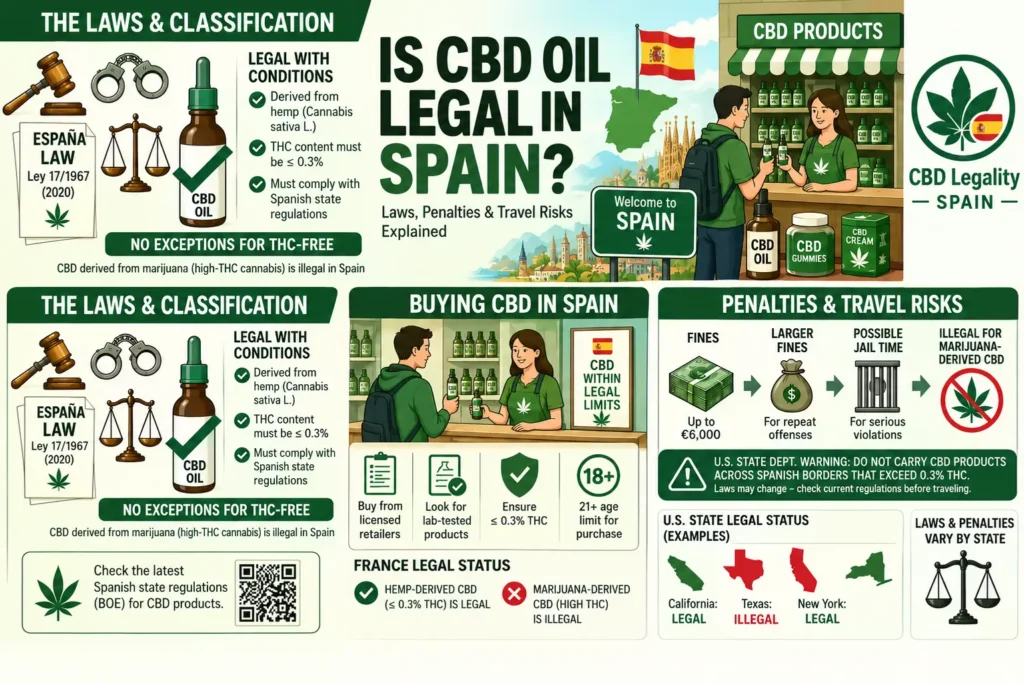

CBD oil is not universally legal in Spain for every purpose. Its legal status depends on its ingredients, intended use, THC content, product classification, and whether it is being sold, used, or transported. CBD cosmetics may be marketed under applicable cosmetics rules, while CBD oil intended to be swallowed faces significant restrictions under European Union novel-food legislation. Medical cannabis preparations are subject to separate controls. Therefore, a product advertised as legal CBD oil is not automatically lawful for every use in Spain.
Key Takeaways
- CBD cosmetics: Must comply with applicable Spanish and EU cosmetics regulations.
- CBD oil for oral consumption: CBD is treated as a novel food ingredient that requires authorisation before it can be marketed as food or a food supplement.
- THC content: THC can trigger additional legal restrictions. There is no safe assumption that every product below a commonly advertised percentage is automatically legal.
- Medical cannabis: Standardised cannabis preparations and authorised medicines follow specific medical rules.
- Travellers: CBD products may be subject to customs, product-classification, and destination-country requirements.
What Is CBD Oil?
Cannabidiol, commonly called CBD, is a compound found in the cannabis plant. Unlike delta-9-tetrahydrocannabinol (THC), it is not generally considered intoxicating in the same way. However, CBD and THC are different substances, and a product’s legal classification cannot be determined simply by whether it produces a high.
CBD oil usually consists of a carrier oil combined with CBD extract. Depending on the formulation, it may contain additional cannabinoids, including small amounts of THC.
The principal product types include:
- CBD isolate: A formulation intended to contain CBD as its principal cannabinoid.
- Broad-spectrum CBD: An extract containing multiple cannabis compounds, usually marketed as having no detectable THC.
- Full-spectrum CBD: An extract containing CBD and other naturally occurring cannabis compounds, potentially including THC.
These commercial descriptions do not establish legal compliance. Laboratory testing, accurate labelling, the intended use, and the applicable product regulations remain important.
Is CBD Oil Legal in Spain for Different Uses?
The most important distinction is between a product applied to the skin, a product intended to be swallowed, and a medicine supplied under medical controls.
| CBD product | General legal position in Spain |
| CBD cosmetic oil | Potentially permitted if it meets applicable cosmetics requirements |
| CBD oil sold as a food supplement | Subject to EU novel-food authorisation requirements |
| CBD oil intended for general oral consumption | Cannot be assumed lawful without the required regulatory authorisation |
| Authorised cannabis-based medicine | Governed by medicines legislation and applicable prescribing rules |
| Product containing THC | May face additional restrictions depending on composition and classification |
This table is a general guide, not a determination that a particular product is lawful. Product formulation and intended use can change the legal analysis.
Is CBD Oil Legal to Swallow in Spain?
CBD oil intended for oral consumption presents a significant regulatory difficulty. The Spanish Agency for Food Safety and Nutrition (AESAN) explains that CBD is considered an unauthorised novel food when used as an ingredient in food, including when added to an oil.
Under EU Regulation 2015/2283, novel foods generally require authorisation before being placed on the market. The European Commission provides further information in its official guide to novel-food legislation.
AESAN’s position is important because it distinguishes a product’s presence in shops from its legal authorisation. A product may be advertised online or sold by a retailer without that fact proving that its intended use complies with food law.
Consumers should therefore avoid assuming that a CBD tincture is legal to swallow simply because it is labelled as hemp oil, sold online, or contains little THC.
Is CBD Oil Legal for Skin Application?
CBD-containing cosmetics are assessed under a different regulatory framework from food supplements. A cosmetic product must comply with Regulation (EC) No 1223/2009, applicable ingredient restrictions, safety requirements, labelling rules, and the obligations placed on the responsible person.
The Spanish Agency of Medicines and Medical Devices (AEMPS) maintains information on Spanish and European cosmetics legislation.
A product’s intended cosmetic use matters. An oil marketed for external application cannot automatically be relabelled or promoted as a product for oral use. Likewise, a cosmetic cannot lawfully make medicinal claims merely because it contains CBD.
Before buying a topical CBD product, check its ingredient list, manufacturer information, intended use, and compliance documentation.
What Do Spanish Authorities Say About CBD?
Official regulatory guidance is more useful than general statements from retailers because it identifies the rules that apply to particular product categories.
1. AESAN on CBD as a Novel Food
AESAN’s official FAQ on CBD and food states, in substance, that CBD is considered an unauthorised novel food, whether used on its own or added to an oil, until the necessary authorisation requirements are met.
This distinction is central to the question of whether CBD oil can legally be consumed as a food supplement in Spain. Read the official AESAN frequently asked questions.
2. The European Commission on Novel Foods
The European Commission explains that a novel food is one that was not consumed to a significant degree by people in the EU before 15 May 1997.
Its guidance states that novel foods must be safe for consumers and properly labelled so that consumers are not misled. These requirements help explain why a CBD product cannot automatically enter the food market merely because CBD is derived from a plant.
See the Commission’s official explanation of novel foods.
3. AEMPS on Cannabis-Based Preparations
Spain’s regulatory framework also distinguishes general CBD consumer products from controlled cannabis preparations used in medical treatment.
Royal Decree 903/2025 establishes conditions for standardised cannabis preparations used in specified compounded medicines. It sets out controls on preparation, dispensing, and use. It does not create blanket permission for all CBD oils sold to consumers.
The official text explains that standardised cannabis preparations containing THC at or above 0.2% by weight are considered psychotropic under the decree’s specific provisions. This threshold must not be interpreted as a universal rule allowing every consumer CBD product below 0.2% THC.
Read Royal Decree 903/2025 in Spain’s Official State Gazette.
What Is the THC Limit for CBD Oil in Spain?
There is no single percentage that makes every CBD product legal for every purpose. THC content is relevant, but the applicable rule depends on the product’s classification and intended use.
Three points deserve particular attention:
- Low THC does not settle every legal question. A CBD oil intended for food consumption may still face novel-food restrictions even when its THC content is very low.
- Medical preparations follow specific rules. The THC threshold in Royal Decree 903/2025 applies within the decree’s regulatory framework and should not be generalised to all products.
- Labels need supporting evidence. A seller’s claim that a product is THC-free or contains only trace amounts should be supported by reliable laboratory analysis.
Consumers should look for a certificate of analysis from a competent laboratory. It should identify the product tested, report cannabinoid levels, and correspond to the batch being sold. Such a certificate helps establish composition, although it does not itself grant legal authorisation.
Can Tourists Bring CBD Oil Into Spain?
Travellers should exercise caution when carrying CBD oil across borders. A product permitted in the country of departure may be restricted in Spain, and the rules can differ according to whether the product is a cosmetic, food supplement, or medicine.
Before travelling, check the following:
- The exact ingredients and THC content.
- Whether the product is intended for oral use or external application.
- Whether it is a prescribed or authorised medicine.
- Whether the quantity and documentation meet the applicable travel and customs requirements.
- Whether the countries on the itinerary impose additional restrictions.
Keep the original packaging and product documentation. If the product is prescribed medicine, carry appropriate medical documentation and confirm whether additional authorisation is needed.
For a broader discussion of international restrictions, read CBD Legality’s guide to CBD import laws for travellers and businesses.
Travellers should not assume that carrying a small bottle for personal use automatically exempts it from applicable rules.
Is Medical CBD Legal in Spain?
Medical cannabis is regulated separately from general retail CBD products. Spain’s Royal Decree 903/2025 establishes a framework for standardised cannabis preparations used in specified compounded medicines, including conditions for their preparation and dispensing.
This is not equivalent to unrestricted access to CBD oil in ordinary shops. A preparation’s availability depends on the applicable medical framework, the product’s status, and the relevant healthcare and pharmacy requirements.
People considering cannabis-based treatment should consult a qualified healthcare professional. They should also check current requirements with the Spanish Agency of Medicines and Medical Devices rather than relying on online sellers’ descriptions.
How to Check Whether a CBD Product Is Legal in Spain
A careful product check should address the following questions.
Step 1: Identify the Intended Use
Determine whether the oil is intended to be swallowed, applied to the skin, or used as a medicine. Different regulatory rules apply to each category.
Step 2: Review the Ingredients
Check whether the product contains CBD, THC, other cannabinoids, or additional ingredients subject to restrictions. Marketing terms such as “natural” or “hemp-derived” do not establish legality.
Step 3: Examine the Product Documentation
Look for a complete ingredient list, traceable manufacturer details, batch-specific laboratory results, and appropriate labelling. For cosmetics, check the applicable regulatory documentation.
Step 4: Verify the Relevant Authorisation
For food products, consult the EU novel-food framework and AESAN guidance. For cosmetics, review the relevant AEMPS rules. For medicinal preparations, check the applicable medicines framework.
Step 5: Check Current Rules Before Travelling or Buying
Regulations and administrative guidance can change. Verify the latest official information before carrying CBD across borders or relying on a product for a particular use.
Further Reading on CBD Laws
CBD regulations differ considerably between countries. A product’s legal status in one jurisdiction does not establish its status elsewhere.
For additional context, see these resources from CBD Legality:
- What Countries Is CBD Illegal? Complete Global Guide 2026
- CBD Import Laws for Travellers and Businesses
You can also explore the site’s Spain legal category for country-specific coverage and its Legal category for broader regulatory information.
Conclusion
The answer to “is CBD oil legal in Spain?” depends on how the product is classified and used. CBD cosmetics may comply with the rules for topical products, but CBD oil intended for oral consumption faces significant restrictions under EU novel-food legislation. THC content, medical status, and cross-border transport requirements must also be considered.
The most reliable approach is to verify the product against official Spanish and European sources before buying, consuming, selling, or travelling with it. For country-specific updates, consult the relevant government guidance and follow CBD Legality‘s coverage of international cannabis regulations.
Frequently Asked Questions
1. Is CBD oil legal in Spain in 2026?
CBD oil is not universally legal for every use. Cosmetics may be permitted when compliant with applicable rules, while CBD intended for oral consumption faces EU novel-food authorisation requirements. Medical cannabis preparations follow separate regulations.
2. Can I buy CBD oil in Spain?
Availability does not establish legality. Before purchasing, identify the product’s intended use, check its composition, and verify that it meets the regulatory requirements for its category.
3. Can I legally swallow CBD oil in Spain?
CBD used as a food ingredient is subject to EU novel-food legislation. AESAN identifies CBD as an unauthorised novel food unless the relevant authorisation requirements are met. Do not assume that a product marketed as a tincture is approved for oral consumption.
4. Is CBD oil with less than 0.2% THC legal in Spain?
Not automatically. THC thresholds apply within particular legal frameworks. A low THC concentration does not remove other restrictions, including those governing CBD in food.
5. Can I take CBD oil on a flight to Spain?
The answer depends on the product, its ingredients, intended use, and applicable travel and customs rules. Check the requirements of Spain and every country on your itinerary before departure.
6. Is CBD cream legal in Spain?
CBD cream may be marketed as a cosmetic if it complies with the applicable EU and Spanish requirements. Its ingredients, safety, labelling, and claims must meet the relevant rules.
7. Is medical CBD available in Spain?
Cannabis-based medicines and standardised cannabis preparations are subject to specific medical regulations. Availability and dispensing depend on the applicable framework and the individual product’s status.