
Yes, CBD is legal in Thailand, provided the product contains less than 0.2 percent THC, a lower threshold than the 0.3 percent standard used in the United States and European Union. CBD oils, capsules, and topicals meeting this limit can be bought without a prescription at pharmacies, wellness shops, and convenience stores across the country. The bigger story is what happened to Thailand’s broader cannabis policy around it. After becoming the first country in Asia to decriminalize cannabis in 2022, Thailand reversed course sharply in June 2025, reclassifying higher-THC cannabis as a controlled substance requiring a Thai medical prescription.
That reversal is the detail most travelers and residents actually need to understand. You can find yourself carrying a CBD product that was perfectly legal to buy in Thailand a few years ago, only to discover the surrounding legal landscape has changed dramatically since, with thousands of dispensaries closed and new rules governing everything from where cannabis can be consumed to what foreign visitors can bring across the border. This guide covers what is legal in Thailand right now and how the country arrived at its current position.
Key Takeaways
- CBD products containing less than 0.2 percent THC are legal in Thailand without a prescription, a stricter threshold than the 0.3 percent standard used in the US and EU.
- Thailand became the first Asian country to decriminalize cannabis in June 2022, but a June 25, 2025 policy reversal reclassified higher-THC cannabis as a controlled herb requiring a Thai medical prescription.
- More than 7,000 of Thailand’s roughly 18,000 cannabis dispensaries closed after failing to meet the compliance requirements introduced in 2025.
- Foreign medical marijuana cards and prescriptions have no legal effect in Thailand; a new prescription from a licensed Thai practitioner is required.
- Public consumption of cannabis, including smoking, is illegal everywhere in Thailand, even for valid prescription holders, and can carry fines up to 25,000 baht and up to three months imprisonment.
- Travelers generally cannot bring CBD or cannabis products into Thailand, even if those products are legal in their home country.
- A comprehensive Cannabis and Hemp Act remains pending before Thailand’s parliament as of 2026, meaning current rules still operate through ministerial notifications rather than a single dedicated statute.
Is CBD Legal in Thailand? The Direct Answer
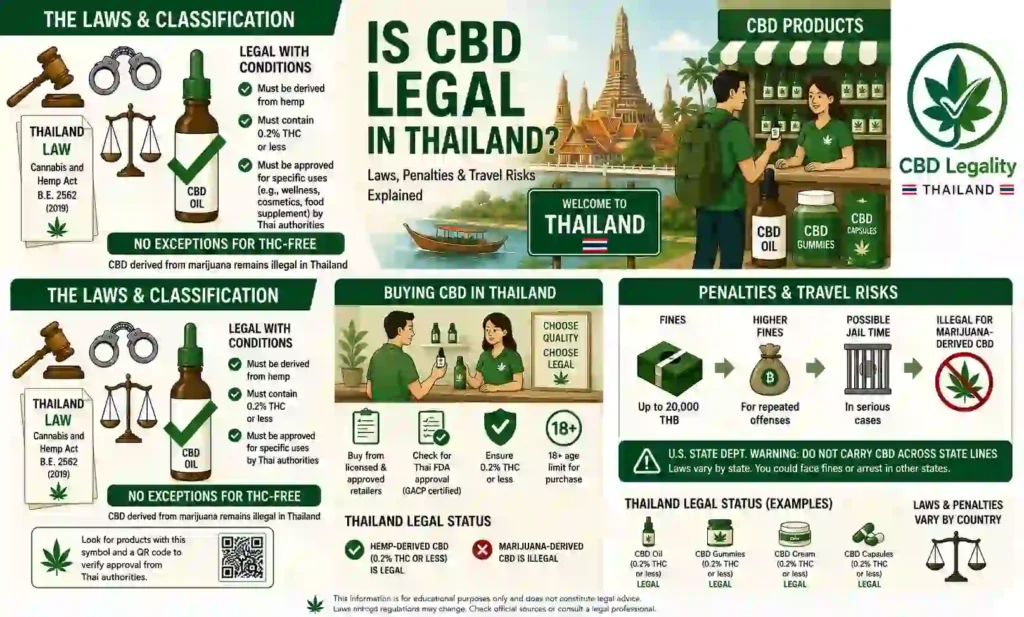
Thailand permits the sale and possession of CBD products containing less than 0.2 percent THC without requiring a prescription or medical consultation. This covers CBD oils, capsules, and topicals, available through pharmacies, wellness retailers, convenience stores, and some online sellers operating within Thailand. Products exceeding that 0.2 percent threshold fall under a different, considerably more restrictive framework, treated as a controlled herb requiring a valid Thai medical prescription to legally possess.
Thailand’s 0.2 Percent THC Threshold: Why It Is Stricter Than the US or EU
Most countries with an established hemp market, including the United States and the European Union, use 0.3 percent as the dividing line between legal hemp-derived CBD and regulated cannabis. Thailand sets this threshold at 0.2 percent, a meaningfully tighter standard. A CBD product legally sold as hemp in the United States could, in principle, exceed Thailand’s own legal limit, which is a detail worth checking carefully for anyone bringing CBD products purchased abroad into the country.
From Decriminalization to Reversal: Thailand’s Cannabis Law Timeline
June 2022: Thailand Decriminalizes Cannabis
Thailand first legalized medical cannabis in 2018, becoming an early mover in Asia. On June 9, 2022, the country went considerably further, removing cannabis from its Category 5 narcotics list and effectively decriminalizing possession and cultivation overnight. Thousands of dispensaries opened in the months that followed, with minimal regulation governing how they operated, and Thailand’s cannabis market attracted global attention as one of the most permissive in the region.
June 25, 2025: The Recriminalization
That permissive period did not last. On June 25, 2025, Thailand’s then Public Health Minister issued a notification reclassifying cannabis flower and extracts containing more than 0.2 percent THC as a controlled herb, requiring a valid prescription for legal possession. The change followed growing political and public concern over the largely unregulated market that had developed since 2022. Politically, the shift coincided with the Bhumjaithai Party, which had championed the original 2022 decriminalization, withdrawing from Thailand’s governing coalition, followed by a change in leadership and a general election held February 8, 2026. Notably, the major parties contesting that election converged on supporting a medical-only cannabis framework going forward, suggesting the tighter 2025 rules are likely to remain Thailand’s settled policy rather than a temporary swing.
What Changed for Dispensaries and Businesses
The 2025 rules required all dispensaries to have a licensed medical practitioner on-site during operating hours, banned online cannabis sales and vending machines, and prohibited sales to anyone under 20 years of age. Enforcement followed quickly. Of the roughly 18,433 cannabis shops operating in Thailand at the market’s peak, more than 7,000 closed after failing to meet the new compliance standards. As of 2026, approximately 11,136 licensed dispensaries remain active, though roughly half of all currently valid licenses are reported to expire within the year, suggesting further consolidation of the market is likely.
Buying Medical Cannabis in Thailand: The PT 33 Prescription System
Legal access to cannabis products above the 0.2 percent THC threshold now runs through a prescription system built around a document known as PT 33. A patient must consult a licensed Thai practitioner, typically a physician, pharmacist, or Thai traditional medicine expert, who can prescribe cannabis for documented medical reasons such as chronic pain, insomnia, or anxiety. A PT 33 prescription is valid for a maximum of 30 days, and patients holding one may possess up to 30 grams of cannabis per month. Purchases must be made through licensed, medically supervised dispensaries rather than the informal shops that characterized the earlier decriminalization era.
Is Recreational Cannabis Legal in Thailand?
No. Under the current framework, recreational cannabis use is illegal in Thailand. Possessing cannabis flower or any product exceeding 0.2 percent THC without a valid PT 33 prescription can result in fines up to 25,000 baht and up to three months of imprisonment.
Public Consumption Is Illegal Everywhere, Even With a Prescription
One of the more commonly misunderstood aspects of Thailand’s current law is that a valid medical prescription does not permit public consumption. Smoking or otherwise consuming cannabis in public spaces, including streets, parks, restaurants, temples, schools, and government buildings, remains illegal for everyone, prescription holders included, and carries the same fines and potential imprisonment described above. Legal consumption is limited to private settings.
What Is Legal and What Is Not in Thailand: Quick Reference
| Product or Activity | Legal Status |
|---|---|
| CBD products under 0.2% THC | Legal, no prescription required |
| Cannabis flower or extracts over 0.2% THC | Legal only with a valid PT 33 prescription |
| Recreational cannabis use | Illegal |
| Public consumption or smoking | Illegal everywhere, regardless of prescription |
| Home cultivation | Requires an FDA Thailand cultivation license |
| Foreign medical marijuana cards | Not recognized |
Traveling to Thailand With CBD or Cannabis
Why Foreign Medical Cards Do Not Work
A medical marijuana card issued in another country, whether from the United States, Canada, or elsewhere, has no legal standing in Thailand. Visitors wishing to access cannabis for medical reasons must consult a licensed Thai practitioner and obtain a new, Thailand-specific PT 33 prescription rather than relying on documentation from home.
What Tourists Should Know Before Packing CBD
Thailand’s Food and Drug Administration takes a restrictive approach toward cannabis and hemp-related products entering the country. In most cases, travelers are not permitted to bring CBD edibles, cannabis-infused foods, cosmetics containing cannabis extracts, or similar products into Thailand, even when those products are entirely legal in the traveler’s home country. Products containing controlled substances above Thailand’s own thresholds must be declared and approved in advance through Thai regulatory channels, a process most casual travelers are not equipped to navigate. The safest approach is to purchase CBD products locally after arriving in Thailand rather than importing them.
The Cannabis and Hemp Act: What Is Still Pending
Thailand’s current cannabis and CBD rules operate through a combination of ministerial notifications and existing pharmaceutical law rather than a single, dedicated statute. A comprehensive Cannabis and Hemp Act, intended to consolidate this patchwork into unified legislation, has been moving through Thailand’s legislative process for several years but remained awaiting a parliamentary vote as of 2026. Until this act passes, Thailand’s cannabis and CBD framework remains subject to change through administrative orders, which is part of why the regulatory landscape has shifted as dramatically as it has since 2022.
Where to Buy Legal CBD in Thailand
CBD products under the 0.2 percent THC threshold are widely available through pharmacies, wellness shops, and convenience stores throughout Thailand, particularly in major cities and tourist areas. Buyers should confirm THC content on product labeling before purchase, since Thailand’s enforcement of the 0.2 percent threshold has grown more consistent following the 2025 policy changes.
Is CBD Legal in Other Countries?
Thailand’s whiplash between decriminalization and reversal offers a useful comparison point for other jurisdictions currently working through their own cannabis policy shifts. For a look at a European country facing its own dramatic reversal on hemp flower specifically, see our guide to CBD legality in Italy. For a comparison with a country maintaining a stricter, prescription-based model throughout, our guide to CBD legality in Norway is worth reviewing.
Frequently Asked Questions
Is CBD legal in Thailand in 2026? Yes. CBD products containing less than 0.2 percent THC are legal to buy and possess in Thailand without a prescription.
Is marijuana legal in Thailand? Marijuana above 0.2 percent THC is legal only with a valid PT 33 prescription obtained from a licensed Thai practitioner. Recreational use without a prescription is illegal.
Can I use my foreign medical marijuana card in Thailand? No. Foreign medical marijuana cards and prescriptions are not recognized in Thailand. A new prescription from a licensed Thai practitioner is required.
Can I bring CBD products into Thailand from my home country? Generally, no. Thailand’s Food and Drug Administration restricts most cannabis and hemp-related imports, even products that are legal at home, so purchasing CBD locally after arrival is the safer approach.
Is it legal to smoke cannabis in public in Thailand? No. Public consumption of cannabis, including smoking, is illegal everywhere in Thailand, even for valid prescription holders, and can result in fines up to 25,000 baht and up to three months imprisonment.
Why did Thailand reverse its cannabis decriminalization? Growing political and public concern over Thailand’s largely unregulated 2022 to 2024 cannabis market led to a June 2025 reclassification requiring medical prescriptions for higher-THC products, a shift that major political parties have since converged around supporting.
Final Conclusion
CBD itself remains straightforwardly legal in Thailand, provided a product falls under the country’s 0.2 percent THC threshold. The larger picture is considerably more complicated, following Thailand’s dramatic swing from the first cannabis decriminalization in Asia to a significant 2025 reversal that closed thousands of dispensaries and reintroduced a prescription-based system for anything beyond that basic CBD threshold. Anyone buying CBD in Thailand should confirm THC content carefully, avoid bringing cannabis-related products across the border without prior approval, and remember that even a valid medical prescription does not permit public consumption anywhere in the country.
July 2026. This article is for informational purposes only and does not constitute legal advice. Readers should confirm current requirements with Thailand’s Food and Drug Administration or a licensed attorney before making purchasing, travel, or business decisions.