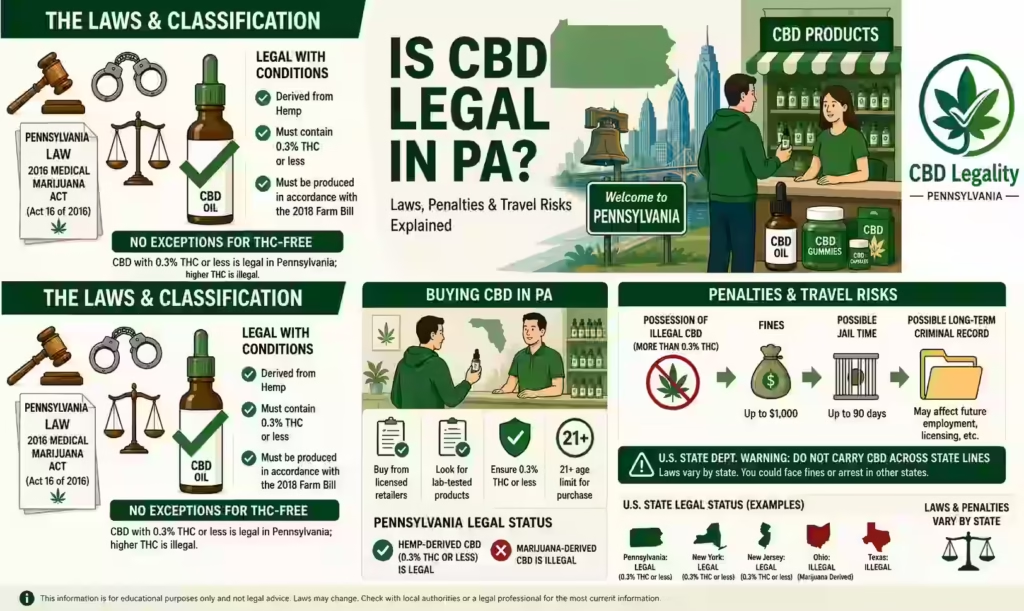

Yes, CBD is legal in Pennsylvania. Hemp-derived CBD containing 0.3 percent THC or less can be bought, sold, possessed, and used throughout the Commonwealth without a prescription or medical card, and Pennsylvania places no possession limit on it. There is one significant exception that trips up a large number of buyers. CBD gummies, infused beverages, and other edible CBD products remain illegal to sell in Pennsylvania, treated as an unapproved food additive under a position the state has maintained since 2022.
That distinction, legal in oil form but not in gummy form, is the detail most searches on this topic actually need answered. You can find yourself in a Pennsylvania shop looking at a CBD tincture right next to a display of CBD gummies, with only one of the two actually complying with state law. This guide explains why that split exists and what else changed in Pennsylvania’s hemp market through 2026.
Key Takeaways
- Hemp-derived CBD with 0.3 percent THC or less is legal in Pennsylvania, with no state possession limit.
- CBD edibles and gummies remain illegal to sell in Pennsylvania as unapproved food additives, a position reaffirmed after a brief 2021 reversal.
- CBD oils, tinctures, capsules, and topicals are not affected by the edibles restriction and remain widely available.
- A 2024 law, Act 67, restricts Delta-8, THC-O, and HHC sales to licensed retailers with mandatory age verification and testing.
- Pennsylvania has a medical-only marijuana program under Act 16, with more than 150 licensed dispensaries statewide.
- Recreational marijuana remains illegal in Pennsylvania, though a bill to create a unified Cannabis Control Board remains alive in the legislature after a close Senate vote in June 2026.
- A federal rule taking effect November 12, 2026, will cap total THC at 0.4 milligrams per container, a standard Pennsylvania will inherit automatically since it defers to the federal hemp definition.
Is CBD Legal in Pennsylvania? The Direct Answer
Pennsylvania permits the purchase, possession, and sale of hemp-derived CBD containing 0.3 percent THC or less, aligned with the federal standard set by the 2018 Farm Bill. This covers oils, tinctures, capsules, and topicals, sold without a state-level retail permit requirement, which is why CBD products turn up in pharmacies, convenience stores, and specialty shops across the state. The complication sits specifically with edible CBD products, a category Pennsylvania regulates differently from nearly every other CBD product type.
The Legal Foundation: Act 92 and Pennsylvania’s Hemp Program
Pennsylvania’s hemp framework began with the Pennsylvania Hemp Research Act, known as Act 92, signed in 2016 and administered by the Pennsylvania Department of Agriculture. This law authorized hemp cultivation and, following USDA approval of the state’s hemp production plan in 2020, transitioned Pennsylvania from a pilot program into a formally recognized hemp industry. The Department of Agriculture enforces the 0.3 percent Delta-9 THC ceiling at the cultivation level, with crops testing above that threshold subject to remediation or destruction.
The CBD Edibles Exception: Why Gummies Are Different From Oils
The 2021 PLCB Reversal
In June 2021, the Pennsylvania Liquor Control Board granted permission for licensed alcohol retailers to sell consumable CBD products, including gummies and infused beverages, creating a brief window where CBD edibles were legally available in certain licensed stores. That changed in April 2022, when the Liquor Control Board reversed course entirely, acting at the direct request of the Pennsylvania Department of Agriculture, which informed the board that selling these consumable products was unlawful in Pennsylvania. The reversal applied statewide, not just to alcohol-licensed retailers, and CBD edibles have remained prohibited for sale ever since.
What Counts as a Food Additive vs a Legal CBD Product
Pennsylvania’s position tracks the federal Food and Drug Administration’s own stance, which has not approved CBD as a food additive and recognizes only a small number of hemp-seed ingredients as safe for use in food. Because gummies, infused drinks, and similar products are consumed as food, they fall under this restriction. Topicals, oils, and tinctures are not consumed as food in the same regulatory sense, which is why they remain unaffected and widely sold.
Act 67 of 2024: New Rules for Intoxicating Hemp Cannabinoids
Delta-8, THC-O, and HHC
Pennsylvania passed Act 67 in 2024, creating a separate regulatory track for intoxicating hemp-derived cannabinoids, including Delta-8 THC, THC-O, HHC, and similar synthesized compounds. Under this law, these products can only be sold through licensed retailers, and sellers must meet specific labeling, testing, and age-verification requirements. Ordinary, non-intoxicating hemp CBD, meaning standard tinctures, topicals, and low-THC products, is not subject to these additional retail restrictions.
Age Verification Requirement
Intoxicating hemp products regulated under Act 67 require buyers to be 21 years of age or older. Standard CBD products outside this category do not carry the same statutory age floor, though individual retailers may still choose to apply one.
What Is Legal and What Is Not in Pennsylvania: Quick Reference
| Product Type | Legal Status | Notes |
|---|---|---|
| CBD oils and tinctures (0.3% THC or less) | Legal | No possession limit, no card required |
| CBD topicals (creams, balms, lotions) | Legal | Applied externally, outside food-additive rules |
| CBD gummies, edibles, infused beverages | Illegal to sell | Treated as an unapproved food additive |
| Delta-8, THC-O, HHC | Legal, restricted | Licensed retailers only, 21+, under Act 67 |
| Marijuana-derived CBD | Legal for registered patients only | Requires Pennsylvania medical marijuana card |
| Recreational marijuana | Illegal | No adult-use program exists |
Pennsylvania’s Medical Marijuana Program
Pennsylvania established its medical cannabis program under Act 16 in 2016, administered by the Department of Health. Dispensaries began operating in 2018, and as of 2026 more than 150 licensed dispensaries serve registered patients statewide. Qualified patients with a valid medical marijuana card can access marijuana-derived products, including high-potency CBD formulations, through licensed dispensaries, and may possess up to a 90-day supply at any given time. This program operates entirely separately from the general hemp-derived CBD market and requires a qualifying condition and state registration to access.
Is Recreational Marijuana Legal in Pennsylvania?
No. Recreational marijuana remains illegal in Pennsylvania. Cannabis has been legal for medical use since 2016, but adult-use sales are prohibited statewide, home cultivation is illegal, and possession outside the medical program can still result in criminal charges, even though cities such as Philadelphia and Pittsburgh have locally decriminalized small amounts.
Senate Bill 49 and the Push for a Cannabis Control Board
Senate Bill 49 would create a Pennsylvania Cannabis Control Board to regulate cannabis and hemp under a single agency, and would ban most intoxicating hemp products to mirror the incoming federal standard. After committee amendments, the full Senate rejected the bill 27 to 23 on June 10, 2026. Senators immediately approved a motion to reconsider, 29 to 21, which keeps the measure eligible to be revived. Separately, the Pennsylvania House passed a broader legalization bill by a single vote in May 2025, the first time either chamber had done so, though it did not become law.
The Federal Change Coming November 12, 2026
A provision included in a federal government funding package signed November 12, 2025, rewrites the hemp definition established by the 2018 Farm Bill, capping total THC at 0.4 milligrams per consumer-facing container rather than the current 0.3 percent by dry weight. This provision, part of Public Law 119-37, takes effect exactly one year later, on November 12, 2026. Because Pennsylvania defers directly to the federal hemp baseline rather than setting its own separate THC standard, this change will apply automatically statewide, and many current products, particularly higher-strength Delta-9 gummies and THCA flower, are likely to fall outside the new federal threshold once it takes effect.
Where to Buy Legal CBD in Pennsylvania
Hemp-derived CBD oils, tinctures, and topicals are widely available through pharmacies, convenience stores, specialty CBD retailers, and online sellers shipping into the state. Because Pennsylvania does not require a state-level retail permit specifically for hemp products, quality and lab-testing practices can vary between sellers.
What to Check Before Buying
Look for a current Certificate of Analysis from an independent, accredited laboratory confirming Delta-9 THC content at or below 0.3 percent. Buyers interested in Delta-8 or other intoxicating hemp cannabinoids should confirm the retailer is properly licensed under Act 67 and enforces the required age verification at the point of sale.
Traveling With CBD in Pennsylvania
Standard hemp-derived CBD oils and topicals that meet the 0.3 percent threshold can generally be carried into or shipped to Pennsylvania without legal issue. Marijuana-derived edibles or THC products purchased legally in another state, such as Colorado or Michigan, remain illegal in Pennsylvania regardless of where they were bought, since Pennsylvania does not recognize out-of-state legalization.
Is CBD Legal in Neighboring States?
Pennsylvania’s edibles restriction is unusual compared to several nearby states. For a comparison with a state currently undergoing its own major hemp overhaul, see our guide to CBD legality in Tennessee. For a look at a state whose current market remains considerably more permissive on intoxicating hemp products, our guide to CBD legality in NC is worth reviewing.
If you are trying to understand how hemp product shipping rules work across additional state lines, our guide on understanding CBD import laws for travelers and businesses explains documentation and compliance risk in more depth.
Frequently Asked Questions
Is CBD legal in Pennsylvania in 2026? Yes. Hemp-derived CBD with 0.3 percent THC or less is legal to buy, possess, and use, with no prescription or state possession limit.
Are CBD gummies legal in Pennsylvania? No. CBD edibles, including gummies and infused beverages, remain illegal to sell in Pennsylvania, treated as an unapproved food additive since the Liquor Control Board reversed a brief 2021 allowance in April 2022.
Is Delta-8 THC legal in Pennsylvania? Yes, but only through licensed retailers that comply with Act 67’s labeling, testing, and 21-plus age-verification requirements.
Does Pennsylvania have a medical marijuana program? Yes. Pennsylvania’s medical marijuana program, established under Act 16 in 2016, serves registered patients through more than 150 licensed dispensaries statewide.
Is recreational marijuana legal in Pennsylvania? No. Recreational marijuana remains illegal statewide, though legislative efforts, including a proposed Cannabis Control Board under Senate Bill 49, remain active as of mid-2026.
Can I bring CBD from another state into Pennsylvania? Standard hemp-derived CBD oils and topicals under 0.3 percent THC generally carry little legal risk, but marijuana-derived THC products legal elsewhere remain illegal in Pennsylvania regardless of origin.
Final Conclusion
CBD is legal in Pennsylvania, but the state draws a clear and often overlooked line between CBD you apply or take in oil form and CBD you eat, with only the first category currently permitted for retail sale. Layer on Act 67’s newer restrictions for intoxicating hemp cannabinoids and a federal total-THC cap arriving in November 2026, and Pennsylvania’s hemp market looks considerably more detailed than the simple 0.3 percent rule most buyers expect. Confirming a product’s category, and its Certificate of Analysis, before buying remains the safest approach in a market still working through these distinctions.
July 2026. This article is for informational purposes only and does not constitute legal advice. Readers should confirm current requirements with the Pennsylvania Department of Agriculture or a licensed attorney before making purchasing or business decisions.